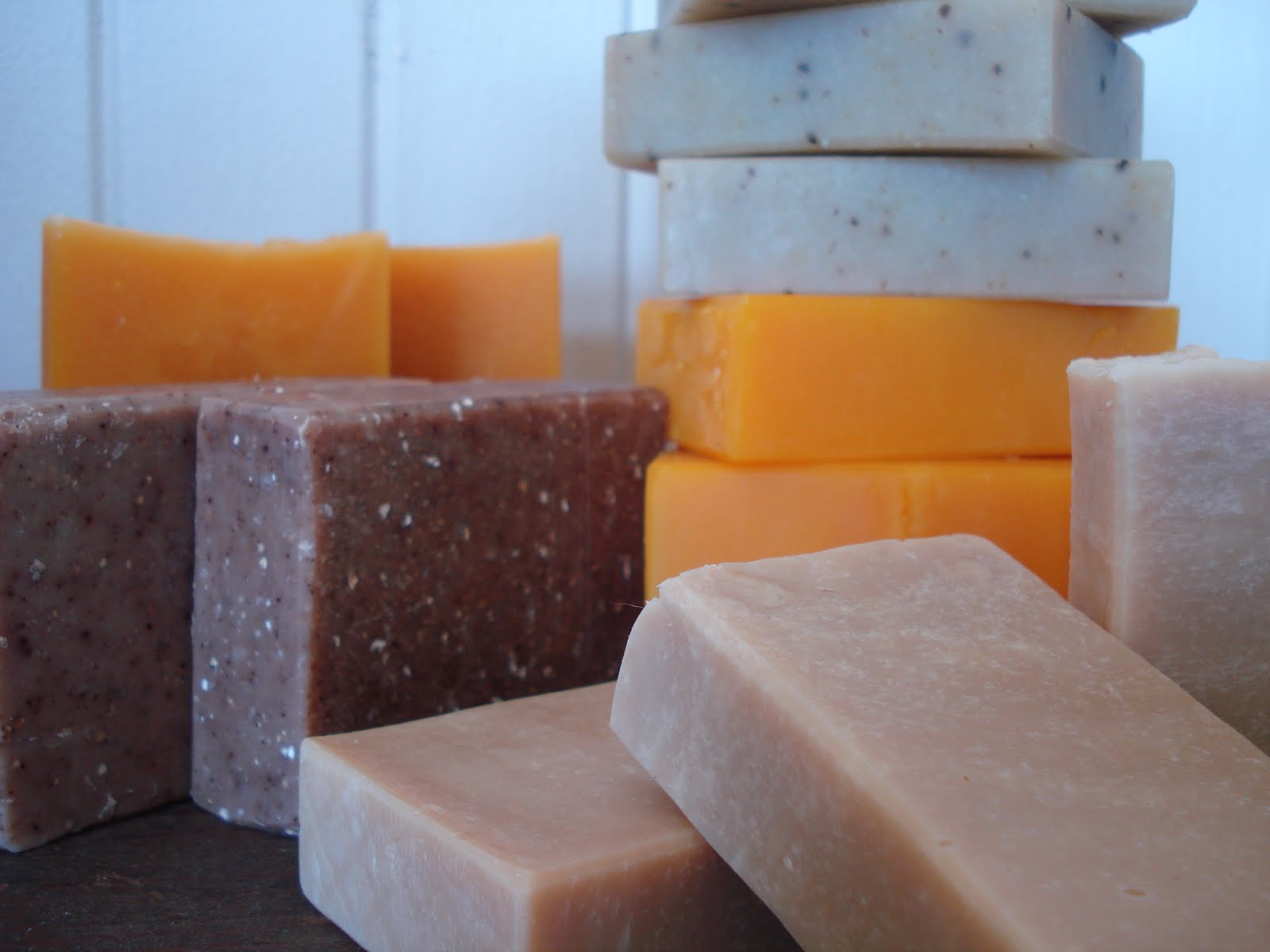
Showing posts with label Sliced Soap. Show all posts

Sunday, February 27, 2011

Sliced Soap: Diary of a Soapmaker

I haven't talked about soap in a while. I've been busy making baby things and such, but I thought I should revisit this topic, as it is a favorite hobby of mine.  Today's soap-making activities have inspired a little offering on techniques.


Not every batch of my delectable soap, believe it or not, comes off smoothly. I blogged about it before, but this time I thought I might share some valuable "learning opportunities" for those of you who are thinking about making soap. Pay attention, Grasshopper, and learn from my mistakes.


Opportunity #1: When making goat's milk soap (cold processed) it separated and never set.
Lesson #1: Milk-based soap is notoriously tricky. I had insulated the mold after filling it (which you should never do).  The top looked solid, so when I turned the mold over to release it, much to my surprise, oil and little rice-sized chunks of soap spilled everywhere. Not to worry, though. I threw the whole debacle back into a pot on the stove, heated it up while stirring, and poured it back into the mold once everything had melted again. Next morning it was good as gold. I have had to conduct several re-do's on this recipe and I suspect that it might have something to do with the clove essential oil. Even with the disasters, this is one of my favorite soaps. When working with milk the trick is to not let it ever get too hot (while mixing it with the lye as well as after it goes into the mold).


Opportunity #2: Not wearing shoes while dealing with the lye.  Ouch. Yes, this can happen to you. A tiny pin-drop of lye must have splashed out and landed on my big toenail.  I never even noticed it until several hours later when the lye had finally burned its way through the nail. The pain was excruciating even though I could hardly even see the damage.
Lesson #2: This should be obvious.


Opportunity #3: Added fresh lavender flowers to the soap.
Lesson #3: They turned brown and looked very unappetizing. I've read that you shouldn't add fresh botanicals as they will "cook" and discolor. Dried is better.


Opportunity #4: Took too long to mix in color. 
Lesson #4: If you want a marbled-colored look to your soap, you need to remove a bit of mixed soap, stir the color into it, and then add it back into the main batch and give it a couple of stirs. Today I took too long and by the time I turned around to add it back in, I could barely get the blender out of the pot; it was stuck firmly into the batch.  I managed to mix the color in and muscle the soap into the mold, pressing it in with a spoon (it was surprisingly still molten hot). Perhaps I'll add a photo of this one to the blog later. I imagine that it will be full of air pockets. The obvious remedy is to work faster, or bring it to a lighter trace before adding the color.  Sometimes the scented oils can speed up trace. I used Aquaflore by Sweet Cakes today (I've never tried it before).


You may read in some literature about soap making that if something goes wrong with your soap batch (i.e. separation, seizing, etc.) that you must throw the batch away and start over. I've found, however, that if I heat it back up, either on the stove or in my huge crock pot, I can rescue the soap and it will still be wonderful. I find it helpful to keep detailed notes about each batch I try. Record your process; the time it took to trace, how long to set, how it turned out - look, lather, etc. Record how the bar appears several months after making it. Also, don't forget to note your mistakes. This will help prevent making the same mistakes again.


I've also read that before you start handing out your soap or start selling it, you should make soap for at least a year. At first I thought this was a ridiculous suggestion as all of my soap batches were wonderful right from the get-go. In hindsight, though, they were absolutely right. Both my recipes and techniques have improved tremendously over the years and I would now be embarrassed to hand out my earlier attempts.  


"Practice is the best of all instructors" - Publilius Syrus (Roman author, 1st century B.C.)

Saturday, May 29, 2010

Chemistry in the kitchen

Yesterday, as I was brewing up a batch of Goat's Milk & Honey soap, I realized that there is a very fine line between being a scientist and soapmaker. In fact, I would go so far as to compare soapmaking with the lost art of alchemy. 


Alchemy, as you might know, is commonly referred to as the medieval chemical science and speculative philosophy aiming to achieve the transmutation of the base metals into gold. Upon closer inspection of Webster, the second definition of alchemy is the power or process of transforming something common into something special. This term definitely fits the bill!


I take common oils and cleverly mix it up with a caustic solution of something that could burn through skin, nails, and unfortunately, commonly enough, esophaguses; and end up with something that is gentle enough to use on a baby's bottom.


But yesterday's scientific experiment almost went out of control. As I was pouring the lye solution into the oils, something went "kerplunk" and splashed toward me. Yes, I was wearing my glasses, but I dodged back and the splash hit my shirt. Whew. Only a drop of oil. Lately, I've been using a Hot Process making my soaps, which is kind of tricky when using a recipe that calls for milk. You want to avoid getting it too hot. Even adding the lye to the water/milk solution has to be done carefully and slowly as to not curdle the milk.


Anyway, onward I went, pouring all of the ingredients into my huge crock pot, giving it a good mix, and leaving it to start it's chemical process called "soaponificaiton" (the reaction of the oils and the lye). I peeked under the lid every once in a while to make sure it was coming along nicely and when the allotted time was up, I was disappointed to see that the oils were still separated. 


"Oh well," I thought. "I can whip it all back together with my hand blender", which is what I did. I then turned around to assemble my mold, and when I turned back the mixture looked like a boiling, churning, hot, brown, mass, rapidly expanding and rising up and over the sides of the pot, streaming down and splashing across the counter (and my recipe book). I quickly grabbed my potholders and pulled the crock out of the base to try to start cooling it down. Once cooled, I had to hand stir it until it mixed back together. I quickly poured it into the mold and let it be. 


Aah, alchemy. The perfect combination of temperature, ingredients, timing, and luck (I mean skill). Luckily, unlike making gold, soap is forgiving, and the batch turned out beautifully. I'll be making plenty of notes about this batch attempt as soon as I can pry my recipe book open again.


Share

Sunday, April 25, 2010

A little about soap-making

For those of you who are budding soap-makers, I thought I'd offer some helpful hints that I discovered in my own self-education with this hobby.


First of all, you need to go to the website: www.millersoap.com. She offers a plethora of information about soap-making; from recipes to how to avoid disasters. She also has a lot of links to soap calculators, and where to pick up supplies. I can't remember if I read it on her site or not, but I did read somewhere that if you are interested in selling soaps, you should really make soap for at least a year to hone your skills. I would agree with this statement 100%! Early on, I made what I thought were great soaps, but as they aged and as I perfected my recipes, I realized that these early attempts were only my first baby-steps to the wonderful soap I can now make.


Secondly, don't use Red Devil lye. This is drain cleaner. I, luckily, didn't have this option, living on a tiny rock 2,000 miles away from any decent soap-making supplies. Instead, I went to http://certified-lye.com/ and bought sodium hydroxide online. This is a high-quality and pure lye that comes in easy-to-use containers. It is non-clumping and you know that you are putting the best ingredient into your final product. Also, their prices are great and their shipping is quick.


I'll write more later on things like oils, recipes, and cold process versus hot process. But these two things are a good starting place for anyone interested in making soap.

Tuesday, April 13, 2010

Sliced Soap: Good old fashioned tar soap

Mmmm mm! Just like Granny used to bathe with. Here I am with more sudsy goodness for you. This is Pine Tar soap. It makes a nice white lather and boasts of pure goodness for your dry and itchy skin. 


In the olden days (circa long-ago) tar soap and other tar-based medicinals had the base ingredient of coal tar.  Some medicinals are still available by prescription, but mostly are not sold because of the carcinogenic nature of coal tar in strong doses. What developed, then, was the use of pine tar as a handy substitute. Same medicinal qualities without the bad side effects.


This 4+oz bar of soap is a bit on the soft side so you would want to be sure to keep it out of standing water when not in use. It has a nice strong smell of pine and rinses nicely. It is made from a blend of coconut, canola, palm, olive, and soy oils with added pine tar and, of course, lye.


If dry and itchy skin bothers you, or eczema or psoriasis leave your skin with dry patches, you may want to give this soap a try. Dandruff? Yes, it can even be used as a shampoo bar! 


If you are interested in some, contact me! ($3/bar plus shipping)

Sunday, February 7, 2010

Recycle, Re-use, Re-mill?

Global warming, climate change, drought, floods, famine...there is definitely a need to do my part in the "greening" movement. My solution: Re-milling. As many of you know, my favorite hobby is making delicious and skin-enriching soaps. Well, sometimes, in my quest to make the perfect body soap, I end up creating soaps that, although wonderful, don't end up on the top of my give-away list and thus linger too long on the shelves in my spare bedroom. The solution? Re-milling.

Re-milling is the process of taking the soap, grating it down into loose flecks, melting it down, and mixing in skin-nurturing goat's milk with a new essential oil. This process can all be accomplished in my energy-saving slow-cooker and the results have been fantastic!

The green soap on the left is a soy bar with tea tree oil. It is not only refreshing, but healing! The orange soap is also a soy bar but with an essential oil mixture of cardamom, sweet orange, lemon, and peppermint. YUM! Today's project (not pictured yet) involves Oatmeal and Honey soap mixed with Goat's Milk and Honey soap, more goat's milk, and cinnamon leaf essential oil. I think I'll name it Cinnamon Honey. Just let me know if you are interested in any of these wonderful soaps and I'll check to see if I have any left.

Sunday, January 10, 2010

Soap by the Slice: Citrus Summer

Yes, it is still winter but we can all enjoy a little bit of summer thanks to my new batch of castile soap. Citrus Summer features olive, castor, and coconut oils to produce a creamy and smooth lathering soap. Essential oils of lemon and ylang ylang make it refreshing and invigorating. Close your eyes and you will be transported back to the sunny days of summer.

Each bath bar is about 4 oz (maybe a little bit more) and they can also be purchased in hand-soap sized (2 oz) as well as travel size (1 oz). For more information and pricing click here.

Tuesday, December 2, 2008

Soap by the Slice: Pandanus with Coconut Milk

Coconut and olive oils combined with lard create a smooth hard soap. Pandanus leaves, collected on Kaua`i, are added to provide skin-healing medicinal qualities, and to give it a nice, natural green tint.

Rosemary essential oil is added and provides clarifying, focusing, inspiring, and invigorating qualities to this soap. Also, a touch of ylang ylang essential oil provides balancing, calming, and anxiety-soothing elements. Added vitamin E helps to restore skin health. You will love bathing with this soap; you will feel as though you are spending time in a spa.

This soap is nicely lathering and will both refresh and soothe your skin, giving you a tropical treat. Bath bars come in large, 4 oz sizes and are $4.00 each. Hand soap and travel sizes are available as well. If you are interested in purchasing this soap and to experience luxury on a budget click here!

Thursday, September 4, 2008

Soap by the slice: Lovely Lavender

The calming summer scent of lavender is infused into this smooth and silky soy-based soap. Even bits of dried lavender flowers are added to help you experience the natural botanical goodness of this 100% vegan soap.

Olive oil is also used to leave the skin moisturized and nourished. Coconut oil makes for a creamy and rich lather.

Free of skin-drying detergents and loaded with natural glycerin, this soap is pure enough to use on a baby! Relax in the tub with one of these 4 oz. hand-made bars.

All my soaps are lovingly made on the island of Kaua`i and can be purchased for $4.00 each, plus shipping. For more information email me!

Wednesday, August 13, 2008

Soap by the slice: Goat's Milk and Honey

Honey and goat's milk are the special ingredients that make this soap so delicious for your skin. Goat's milk is wonderful for the skin. It contains naturally occurring alpha-hydroxyl acids (aha), which contribute to a micro-peeling of the skin, gentry scrubbing off dead skin cells. The low ph level is close to that of skin, making it a very gentle exfoliate. Goat's milk also contains high levels of nutrients (including, but not limited to: vitamins A, B-complex and C, and Zinc); elements that nourish and rejuvenate dehydrated skin.

The fat globules of goat's milk are small, allowing for fast and easy absorption into the skin, bringing with it the nutrients, restorative proteins, and moisture. This helps nourish the newly-grown skin and encourages the production of elastin. New skin emerges smooth, healthy and younger looking.

Clove adds anti-fungal and antibacterial properties. Honey is primarily known for its humectant and antimicrobial qualities. (A humectant is a compound that attracts moisture to itself and helps retain the moisture.) This soap is silky smooth and nourishing for your skin.

Interested in purchasing this soap? These bars are about 3 oz. and are $3.50 each. If you are interested in purchasing some, please contact me!

Sunday, July 27, 2008

Soap by the slice: Sesame Delight


Oh my gosh, you are going to love this! A combination of sesame, soy, palm and olive oils makes this soap nourishing and leaves the skin soft and supple. Eucalyptus essential oil helps kill bacteria and clears nasal passages. Coconut oil creates a rich lather. This is a 100% Vegan soap.

Research shows that sesame seed oil is a potent antioxidant. In the tissues beneath the skin, this oil will neutralize oxygen radicals. It penetrates into the skin quickly and enters the blood stream through the capillaries. Molecules of sesame seed oil maintain good cholesterol (HDL) and lower bad cholesterol (LDL).

The principal active ingredient in eucalyptus oil is "eucalyptol" which has strong germicidal and disinfectant properties. A naturally occurring chemical found in extra-virgin olive oils is a non-steroidal anti-inflammatory agent. This soap lathers well and leaves the skin smooth, soft, and nourished. This soap is excellent for use in shaving legs as it makes a nice and creamy lather and moisturizes the skin.

Interested in purchasing a 4 oz. bath bar? This soap is $4.50 each. Contact me if you would like to order some.

Wednesday, July 23, 2008

Soap by the slice: Conditioning Bar

Filled with the rich emollients
of palm, coconut, canola, and castor oils, this hard soap leaves your skin smooth and silky. I added Ocean Mist essential oil to complete this refreshing experience. This soap is 100% Vegan. It can also be used as a shampoo bar.

The oil palm (Elaeis guineensis) is native to West Africa, where local populations have used it to make foodstuffs, medicines, woven material and wine. This soap features red palm oil which is a rich source of vitamin A in the form of Cartenoids (a family of natural fat-soluble nutrients important for antioxidant defense). It is also a wonderful natural source of Vitamin E. This soap also is rich in lauric acid which is believed to have antimicrobial properties. Castor oil is also said to be great for dry skin conditions, the lubricant in the castor oil helps ease the roughness of the skin.

Yes, you CAN purchase this soap. I have it in 4 oz. bars ($4.00 each) as well as 1 oz. travel sized versions ($1.00 each). If you are interested in purchasing some email me. This soap is one of my favorites. It has such a nice lather and leaves my skin so soft!

Sunday, July 20, 2008

Soap by the slice: Oatmeal & Honey


Breakfast or soap? Yes, I make soap!

This old-fashioned soap is made with new ingredients. Coconut and olive oils combined with lard are the base for this skin-nourishing soap. Honey from macadamia orchards in Hilo, Hawaii serves as a natural humectant (a humectant is a compound that attracts moisture to itself and helps retain the moisture) with antimicrobial properties. Added cinnamon is strongly stimulating to the skin and warms the body.

Some researchers believe people first discovered the skin-soothing effects of oatmeal nearly 4,000 years ago. In this handmade soap, oatmeal also acts as a gentle exfoliant.

If you are interested in purchasing this 4 oz. bath bar, for $4.00 each, contact me. I also have 1 oz. travel bars available for $1.00 each.